REFERENCE
Bhaishajya Ratnavali – Vatavyadhirogadhikar (26/141–144)
ABSTRACT
Neurological and musculoskeletal disorders have witnessed a sharp rise in the modern era due to lifestyle irregularities, aging populations, and chronic stress. In Ayurveda, such conditions are broadly classified under Vatavyadhi (Vata-dominant disorders), which encompass a wide spectrum of ailments including Pakshaghata (hemiplegia), Ardita (facial paralysis), Apasmara (epilepsy), Kampavata (tremors/Parkinsonism), Bhrama (vertigo), and Nidranasha (insomnia). The Vata Dosha (air and ether bioenergy) plays a role in governing nervous system activity, and its imbalance results in both physical and psychological disturbances. Vrihat Vat Chintamani Ras is a time-honored herbomineral formulation renowned for its profound efficacy in managing Vatavyadhi. It nourishes Majja Dhatu (nervous tissue), restores Vata equilibrium, and rejuvenates debilitated systems. Its targeted neuroprotective and Rasayana (rejuvenating) action makes it indispensable in today's context, where neurodegenerative, psychosomatic, and vascular conditions continue to challenge holistic health care.
INTRODUCTION
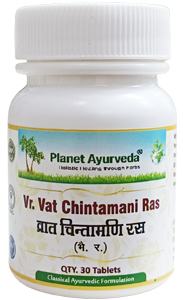
Vrihat Vat Chintamani Ras translates to "The great gem-like medicine that alleviates the worries of aggravated Vata." It is renowned for its ability to rejuvenate the nervous system, nourish the Majja Dhatu (bone marrow/nervous tissue), and pacify deranged Vata Dosha. It is rich in precious metal Bhasmas (clax) like Swarna (Gold), Rajata (Silver), and Abhraka (Mica), and powered by Rasa Sindura (Purified red sulphide of mercury), it delivers fast and deep therapeutic effects when used under expert guidance.
CLASSICAL INDICATION
Vatavyadhi (Diseases associated with the Vata element)
INGREDIENTS
- Swarna Bhasma – Bhasma (Calx) of Gold – 3 parts
- Rajata Bhasma – Bhasma (Calx) of Silver – 2 parts
- Abhraka Bhasma – Bhasma (calx) of Mica – 2 parts
- Loha Bhasma – Bhasma (Calx) of Iron – 5 parts
- Pravala Bhasma – Bhasma (Calx) of Coral – 3 parts
- Mukta Bhasma – Bhasma (Calx) of Pearl – 3 parts
- Suta Bhasma – A compound of purified and processed Mercury and Purified Sulphur – 7 parts
- The juice extract of Aloe vera- Quantity sufficient.


INGREDIENT DESCRIPTIONS
1. Swarna Bhasma (Gold Calx)
Swarna Bhasma is a finely prepared calx of purified gold known for its Rasayana (rejuvenating), Medhya (cognitive-enhancing), and Balya (strength-promoting) actions. It possesses Madhura (sweet) and Tikta Rasa (bitter taste), Laghu (light) and Snigdha Guna (unctuous qualities), Sheeta Virya (cool potency), and acts predominantly on Rasa, Rakta, and Majja Dhatus (plasma, blood, and nerve tissue). In Vrihat Vat Chintamani Ras, it plays a pivotal role in restoring nervous tissue, boosting Ojas (vital essence), and enhancing intellectual capacity, especially in degenerative Vata disorders like Apasmara (epilepsy) and Ardita (facial paralysis).
2. Rajata Bhasma (Silver Calx)
Rajata Bhasma is a calx of purified silver that has Sheetala (cooling), Pittashamak (Pitta-pacifying), and Vatahara (Vata-pacifying) properties. It has Madhura-Tikta Rasa (sweet and bitter taste), Sheeta Virya (cold potency), and is highly effective in calming psychosomatic disorders. In this formulation, it stabilises Manas (mind), supports Majja Dhatu, and manages symptoms like anxiety, restlessness, and neurological excitability.
3. Abhraka Bhasma (Mica Calx)
Abhraka Bhasma (especially Sahasraputi – calcined a thousand times) is an essential Rasayana for Majja and Shukra Dhatu (nervous and reproductive tissues). It is Tridoshaghna (balances all three doshas) and possesses Ushna Virya (hot potency), Sara (mobile), and Laghu Guna (light property). In Vrihat Vat Chintamani Ras, it promotes nerve regeneration, strengthens the spine, improves respiratory strength, and acts as a base for the bioavailability of other metallic Bhasmas.
4. Loha Bhasma (Iron Calx)
Loha Bhasma is a processed calx of iron known for its Raktavardhaka (blood-enriching), Balya (strengthening), and Pushtikara (nourishing) qualities. It is Tikta (bitter) and Kashaya Rasa (astringent taste) in nature, with Ushna Virya (hot potency) and Laghu Guna (light quality). Its primary role in this formulation is to improve blood circulation to the nervous tissue, combat fatigue (Daurbalya), and ensure oxygenation and nourishment of the brain and spinal cord.
5. Pravala Bhasma (Coral Calx)
Pravala Bhasma is a calx of marine coral, rich in bioavailable calcium. It has Sheetala Virya (cool potency), Tikta-Madhura Rasa (bitter-sweet taste), and Laghu-Ruksha Guna (light and dry qualities). It plays a vital role in calming Pitta Dosha, reduces burning sensations in neurological disorders, and helps reduce neuromuscular irritability and involuntary tremors (Kampavata).
6. Mukta Bhasma (Pearl Calx)
Mukta Bhasma is prepared from natural pearls and is rich in organic calcium and trace minerals. It has Sheetala Virya (cool potency), Madhura Rasa (sweet taste), and acts as a Manasashamak (mind stabiliser) and Pittashamak (Pitta-pacifier). In Vrihat Vat Chintamani Ras, it supports cognitive stability, helps in conditions of anxiety, emotional instability, and acts as a soothing agent in epileptic and convulsive disorders.
7. Rasa Sindura (Red Sulphide of Mercury)
Rasa Sindura is a classical compound prepared from purified Hingula (red sulphide of mercury) through the Kupipakwa Rasayana method. It exhibits Yogavahi (catalytic), Rasayana (rejuvenative), Jeevaniya (life-promoting) and Krimighna (antimicrobial) actions. It is Tikshna (sharp) and Ushna Virya (hot in potency), enhancing deep tissue absorption. In this formulation, Rasa Sindura (Red Sulphide of Mercury) improves the therapeutic potential of all ingredients, ensures faster cellular regeneration, and acts as a powerful neuro-tonic, particularly effective in deep-seated Vata disorders.
8. Kumari Swarasa (Juice of Aloe Vera)
Kumari Swarasa (Juice of Aloe vera) is used as the Bhavana Dravya (levigating liquid) in this preparation. It has Tikta (bitter) and Kashaya Rasa (astringent taste), Ushna Virya (hot potency), and works as a Rasayana (rejuvenator), Deepana (digestive enhancer), and Vatahara (Vata pacifier). It potentiates the nervine effects of the formulation, enhances bioavailability of metallic ingredients, and offers mild laxative and anti-inflammatory properties to protect against constipation and inflammation often associated with Vata disorders.
METHOD OF PREPARATION
All the Bhasmas and Rasa Sindura are triturated together in a clean stone mortar. Bhavana (levigation) is done using Kumari Swarasa (Juice of Aloe vera) for 7 days. The mixture is then formed into tablets of 250 mg (2 Ratti) each, dried in the shade, and stored in airtight glass containers.
MEDICINAL PROPERTIES
- Rejuvenator (Rasayana)
- Strength-promoting (Balya)
- Vitality enhancer (Ojasvardhak)
- Cardiac stimulant (Hridaya Utthejak)
- Nerve tissue nourisher (Majjavardhak)
- Brain tonic (Medhya)
- Vata-pacifying (Vatahara)
DOSHA IMPACT
- Vata: Profoundly pacifies deranged Vata in Majja and Snayu (nerves and ligaments)
- Pitta: Mildly Pitta-pacifying due to Rajata (Silver), Mukta (Pearl), and Pravala (Coral)
- Kapha: Neutral
INDICATIONS
- Hemiplegia (Pakshaghata
- Facial paralysis (Ardita)
- Epilepsy (Apasmara)
- Tremors, Parkinsonism (Kampavata)
- Vertigo (Bhrama)
- Fainting spells (Murcha)
- Psychosis (Unmada)
- Insomnia (Nidranasha)
- General debility (Daurbalya)
DOSAGE
250 mg, once or twice daily, as directed by the physician.
ANUPAAN (ADJUVANTS)
It is written in the classical text that this formulation can be used to destroy a wide range of diseases or syndromes, when given with a suitable adjuvant (anupaan), especially the diseases of Vata and Pitta dosha. Here are a few examples-
- Vacha Churna with Honey – for Apasmara (Epilepsy/tremors) or speech delay
- Cow's Ghee – for degenerative nerve conditions
- Ashwagandha Kwath – for neuromuscular weakness
- Brahmi Swarasa – for cognitive disorders
CONTRAINDICATIONS
- Should be used under supervision
- Not suitable during pregnancy and lactation
- Avoid in acute febrile conditions
- Children and the elderly to use only under prescription
WHY CHOOSE PLANET AYURVEDA?
- This formulation is prepared under the guidance of expert Ayurvedic physicians, strictly following the classical reference from Bhaishajya Ratnavali.
- Made using authentic Sahasraputi Bhasmas and high-quality herbal extracts to ensure efficacy and safety.
- Especially beneficial for promoting neurological health, enhancing vitality, and supporting cognitive strength.
- 100% natural and purely vegetarian product, safe for long-term use under expert supervision.
- Completely free from harmful chemicals, preservatives, starch, artificial colors, yeast, binders, and fillers.
CONCLUSION
Vrihat Vat Chintamani Ras is a time-tested Rasayana (rejuvenating medicine) for combating chronic Vata disorders affecting the brain, spinal cord, and nerves. It has been mentioned in the texts that it can bring back the youth-like strength even in old age people. It enhances vitality, intellect, and physical strength. This formulation, when used judiciously with appropriate Anupaan (adjuvant) and under expert guidance, provides profound improvements in neuro-muscular health, cognition, and overall vitality. A true gem in the arsenal of classical Ayurvedic formulations.