
ABSTRACT
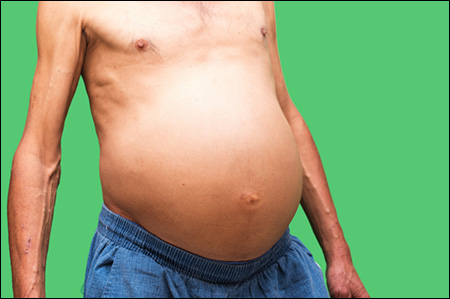
Chylous Ascites is a rare form of Ascites. This occurs when the chyle (milky fluid) forms in the intestine during the digestion process and it collects in the peritoneal or retroperitoneal cavity. It occurs when there is a rupture or trauma in the lymphatic system of the body. The chyle is milky in appearance due to the presence of triglyceride in the fluid. As water and fluid accumulate in the peritoneal cavity it leads to ascites. The liver secretes fluid in the body and when it secretes in large amounts the excess fluid is stored in the peritoneal cavity. As a result of chylous ascites various symptoms form and affect the normal functioning of the body.
INTRODUCTION
As we know it is a form of ascites where milky fluid chyle collects in the peritoneal cavity and leads to lymphatic disorder. As a result of high venous pressure, and lymphatic injuries it leads to lymphatic flow disorder. As the fluid leakage is there it may go to the chest, abdomen, and other cavities of the body and show various symptoms such as electrolyte imbalance, abdominal dissension, and dehydration. When it is left untreated it may lead to stomach distension, difficulty in eating, abdominal distension, and difficulty in breathing and leads to lymphatic disorder in the body. As lymph vessels carry the lymph fluid, the lymph fluid goes to the blood and plays the functioning of the immune system and the transportation of fat and protein in the body.
CAUSES
The Chylous ascites show various symptoms such as-
- Injury to the lymphatic system
- Benign and malignant cause
- Congenital syndrome such as Turner syndrome
- Obstruction in vessel
- Inflammation
- Portal hypertension
- Systemic disease
- Hepatic cirrhosis
- Systemic disease
SYMPTOMS
The chylous ascites have the following symptoms-
- Abdominal swelling
- Difficulty in breathing
- Difficulty in eating
- Malnutrition
- Electrolyte imbalance
- Dehydration
- Anorexia
- Edema
- Swelling in the legs
- Fever
- Vomiting
- Big belly as a result of fluid stored in the cavity
- Anorexia
- Lymph vessels are enlarged
- Increase in weight
- Increased abdominal pressure
- Night sweat
DIAGNOSIS
As per the clinical examination and medical history taken by the physician. The following tests are done for chylous ascites-
- Blood test
- Cytology to assess malignant ascites
- Abdominal paracentesis
- Ascetic fluid examination to assess triglyceride in fluid
- Peritoneal biopsy to detect cancer cells in fluid
- CT (Computerized tomography) to detect the fluid
- MRI (Magnetic resonance imaging) to detect malignancy
- Lymphangiography to reveal oozing of contrast in the abdominal cavity
- USG of the Abdomen to confirm the ascites easily
- Lipoprotein electrophoresis to check the presence of chylomicrons in fluid
- Lymphoscintigraphy to detect leakage of fluid
TREATMENT
- Diet
- Take a low-fat and protein-rich diet
- Paracentesis
- Lymph angiography
- Removal of fluid with the help of a surgical needle
- Surgical treatment
AYURVEDIC ASPECT FOR CHYLOUS ASCITES
As we know Chylous Ascites is a rare type of ascites. As Acharya Charak described च.चि.१३ chylous ascites are considered under Jalodar rog which is one type of Udar rog. It is the result of vitiation of tridoshas that are vata, pitta, and kapha. Udar Rog is described under astamahagada. It occurs due to low digestive fire and an increase in mala. Due to Vikruti of prana vayu and apana vayu, it leads to dusti of sweda vaha and ambuvaha srotas.
Introduction
च.चि.१३ Jalodar is described as an accumulation of fluid in the skin and the tissue that causes distension in the abdomen is known as jalodar. It is due to vikruti of Prana vayu and apan vayu.
Causes
- Due to the intake of excessive water
- Intake of more salt
- Improper diet
- Pancreatitis
- More sitting posture
- Low digestive fire
- Taking more oily food
- Intake of more packaged food
- Infections
- Kidney failure
Pathophysiology
च.चि.१३।४५-४६ Acharya describes the pathophysiology of Jalodar-
As a person intakes oleation therapy and after this intakes more water as a result their digestive fire becomes low and the vessels are filled by air. As an obstruction in the lymphatic system, it prevents the absorption of fluid and protein in the cavity and fluid stored in the abdominal cavity.
Symptoms Of Chylous Ascites
The following are the clinical features of chylous ascites-
- Anorexia (loss of appetite)
- Difficulty in breathing
- Everted umbilicus
- Abdominal distension
- Swelling in abdomen
- Weight gain
- Edema
- Indigestion
- Loss of strength
Complications
- Hepatorenal syndrome due to obstruction of channels
- Intestinal perforation due to infection
- Hepatic encephalopathy
Treatment
- Intake of kshara medicine such as cow urine
- Intake of milk
- Fasting
- Intake of medicated ghee with rock salt
- Shastra Karma (Surgical treatment)
HERBAL REMEDIES FOR CHYLOUS ASCITES BY PLANET AYURVEDA
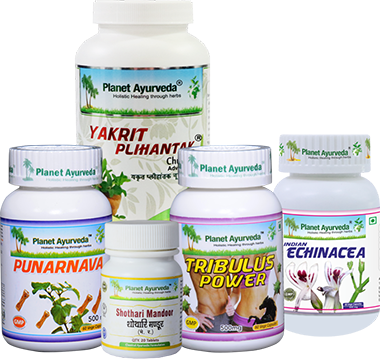
Planet Ayurveda provides an herbal medicine to cure the disease. The herbal medicines are 100% pure and safe as they are free from any adulterants, preservatives, yeast, fillers, or chemicals. In modern treatment, after drainage of fluid, there are chances of recurrence but in Ayurveda, after taking herbal medicine there is no recurrence of fluid in the cavity. For the treatment of Chylous Ascites, Planet Ayurveda provides herbal medicines that are easy to use and have no side effects. The list is described below-
PRODUCT LIST
- Punarnava Capsules
- Shothari Mandoor
- Tribulus Powder
- Indian Echinacea
- Yakrit Plihantak Churna
Herbal Remedies For Chylous Ascites

PRODUCT DESCRIPTION
1. Punarnava Capsules
The Punarnava Capsules are made up of a single drug extraction of punarnava (Boerhaavia diffusa). It helps to reduce fluid from the cavity and edema. As it removes excess fluid from the body the size of the spleen is decreased. As size is reduced it reduces swelling, inflammation, and bacteria in the body. The liver is affected in ascites; it protects the liver from damage. Punarnava acts as a diuretic; it regulates kidney functions and reduces urinary retention and digestion of fat.
Dosage- 2 capsules twice daily, with plain water, after meals.
2. Shothari Mandoor
It is a classical formulation formed by the mixture of many drugs. It contains Mandoor bhasma (Calx of iron), Shunthi (Zingiber officinale), Chavya (Piper chaba), Maricha (Piper nigrum), Pippali (Piper longum), Gomutra (cows urine), Madhu (Honey), and many other herbs. It pacifies all three doshas. It reduces the edema, Inflammation, and swelling of the abdomen. As fluid is excess in the abdomen the digestive fire will become slow so It helps in digestion and improves the metabolism of the body. It stimulates liver function so it is helpful in the loss of appetite. It is the best source of iron so helpful in treating anaemia.
Dosage- 2 tablets twice daily with plain water after meals.
3. Tribulus Powder
It is a capsule-form formulation that is prepared by standardised extraction of Tribulus terrestris (Gokshura). It pacifies all three doshas. As Gokshura is sweet in taste and has cold potency, It is useful in increasing patient strength and reducing swelling. It helps to treat renal problems, edema, and urinary problems. It is a natural diuretic so helps in removing excess fluid.
Dosage- 1 capsule twice daily, with plain water, after meals.
4. Indian Echinacea
These capsules are made from Indian Echinacea (Andrographis paniculata). The capsules are made up of natural herbs without any type of adulterant. Kalmegh has hepatoprotective properties so it helps to maintain a healthy liver. It improves digestion as it has laxative properties. Due to excess fluid, the digestive fire will become low as Kalmega balances the vitiated pitta and kapha dosha which increase the low digestive fire and improve appetite.
Dosage- 1 capsule twice daily, with plain water, after meals.
5. Yakrit Plihantak Churna
Yakrit Plihantak Churna is made up of a combination of drugs such as Bhringraj (Eclipta alba), Bhumiamla (Phyllanthus niruri), Sharpunkha (Tephrosia purpurea), Kalmegha (Andrographis paniculata), and Kaasni (Cichorium intybus). It is helpful in liver and spleen disorders. It helps to remove toxins from the liver so improves liver function. It generates liver cells so helpful in liver inflammation and enlargement. The Giloy element helps to correct liver metabolism, as it acts as an immunomodulator.
Dosage- 1 teaspoonful twice daily, with plain water, after meals.
CONCLUSION
As we studied in this article liver disease is the cause of Chylous Ascites. With the help of proper diet and proper medicine, it is possible to cure. In modern treatments such as tapping and fluid removal by needle, after this, there is a higher chance of recurrence. In Ayurveda, this condition is correlated with Jaloder which is a type of udar rog. In which vata dosha is vitiated. Usually, treatment is based on the symptoms and severity of the disease. The formulations offered by Planet Ayurveda such as Punarnava capsules, Shothari mandoor, Tribulus powder, Indian echinacea, and Yakrit plihantak churna are effective in curing Chylous Ascites.


