Search This Blog

Dr. Vikram Chauhan - MD (Ayurveda)

Showing posts with label Ayurvedic Overview. Show all posts

Thursday, March 6, 2025

How Food Preservatives Impacting Your Immune System? Food Additives are Making You Sick

ABSTRACT

Unfortunately, the word "preservative" is associated with negative connotations. There are several food additives, including artificial preservatives, that have similar negative effects. Everyone wants to eat clean and healthy food, so health comes first. There is a wide variety of processed and canned food products on the market. This affects many children, adults, and senior citizens, causing serious and life-threatening problems. The artificial preservatives harm the heart, liver, immune cells, kidneys, and other parts of the body. To avoid all of these serious health concerns, Planet Ayurveda created the "immunity care kit," which contains a variety of essential herbs that aid in the natural regeneration of immune cells and the fight against infectious diseases.

Preservative, Natural Preservatives, Artificial Preservatives, Types Of Preservatives, How Do Preservatives Work, Ayurvedic Overview, Herbal Remedies, Boost The Immune System

Keywords: natural and artificial preservatives, salt and sugar, TBHQ, food additives, immune boosters, standardized herbs, vikramprash, cancer-causing additives.

WHAT ARE PRESERVATIVES?

Preservatives are food additives that help food last longer and taste better. Preservatives were added to prevent food spoilage, making the food appear fresh even if it was prepared several days before. Food's odor, texture, color, and taste all appear to be the same, making it difficult to distinguish between fresh and unfresh foods.

HOW DO PRESERVATIVES WORK?

Preservatives help to control and prevent food deterioration, providing protection against spoilage caused by microbes such as bacteria, yeast, molds, and fungi. Preservatives are substances that play a crucial role in preventing foodborne illnesses and maintaining the quality of various products. They work by inhibiting the growth of microorganisms such as bacteria, yeasts, and molds, which can cause food spoilage and illness. Additionally, preservatives can slow down or stop oxidation, a chemical reaction that can lead to the degradation of food and other perishable items. By doing so, preservatives help extend the shelf life of products and ensure their safety and quality for consumers.

TYPES OF PRESERVATIVES

There are natural and artificial types of preservatives that have been added to the food products. Broadly, preservatives are categorized as antioxidants. To prevent the growth of bacteria, yeast, fungi and certain microbes. It is sometimes mandatory to use food additives, such as in pickles, where we add excess oil for its increased shelf life.

Table No. 1 - Below the table show the natural and artificial preservatives


Natural Preservatives Artificial Preservatives
The natural ones are derived from natural sources such as plants and animals. These are only made and synthesized in laboratories with the help of chemicals.
Oil, sugar, salt, vinegar, organic acids, and spices are among the listed ingredients. All of these act together to form a layer on the food surface. Nitrites, sodium benzoate, potassium sorbate, sulfites, and propionic acid are a few examples. These have a high shelf life.

Table No. 2 - Below the table shows the antioxidant and antimicrobial preservatives


Antioxidant Preservatives Antimicrobial Preservatives
Antioxidants are the compounds that delay or prevent the spoilage of food. Prevent the growth of microbes, bacteria, fungi and many others in cosmetics, food and pharmaceuticals as well.
Ascorbic acid (vit. C and ascorbates): in bakery wares, fruit juices, drinks and unprocessed fruits and vegetables. Sorbic acid and sorbate are commonly used in processed cheese, fruit and vegetables, bread rolls, and in fine bakery products.
Butylated hydroxyanisole BHA & BHT (hydroxytoulene): Oils, fat-containing products (lipids and glycerides). Benzoic acid and benzoate: used in flavoring fermented milk products; also in processed fish and fishery products.
Citric acids: Non - alcoholic beverages, Jams, Jellies, sauces, cheese, and canned vegetables. Natamycin: used over the surface of cheese and sausage.
Sulfur dioxide and sulfite compounds: dry fruits, fruit preservatives, potato products , mild beverages like wine. Propionic acids and propionates: vinegar, cheese and milk products, and coffee.
Nitrate and nitrite compounds: meat products, pizza, wraps/rolls sandwiches, and poultry products.

WHICH FOOD ADITIVES SHOULD BE AVOIDED?

A number of reasons are present there to avoid the food additives and preservatives that are present in the packages and processed food. These are all added to help keep food fresh longer and also reduce the risk of contamination. Not all the food additives are harmful; there are a few that can be strictly avoided, as discussed below:

Preservative Description Disease
TRANS FAT Trans fats, as seen on grocery store labels, are mentioned on the back of the packet. Companies add hydrogen to oil during the manufacturing process to change the texture and increase the shelf life of packaged food. Increases the risk of cardiovascular disease, type 2 diabetes and stroke.
SODIUM NITRITE This inhibits the growth of harmful bacteria in canned tuna, meats, and sausages. Pancreatic cancer, liver failure.
MONOSODIUM GLUTAMATE (MSG) It is comparable to salt or sugar. It is commonly used to enhance the flavor of savory dishes, particularly in Chinese and fast food. Chest pain, heart palpitations, nausea, weakness, numbness, tingling or burning in the face.
ARTIFICIAL FOOD COLOURING Edible food colors are used to color drinks and other foods. Harmful colorings are: yellow 5 and yellow 6, blue 1 and blue 2, and red dye 3. Hyperactivity, allergies, asthma attack.
HIGH FRUCTOSE CORN SYRUP It is less expensive than cane sugar, which is why manufacturers use this syrup. Found in sweet beverages, frozen pizza, cocktail peanuts, and even bread contains HFCS. Higher risk of NAFLD, obesity, and Type 2 diabetes.
ASPARTAME Artificial sweeteners are commonly used in diet or sugar-free sodas, chewing gum, jellies, Kool-Aid, and even chewable vitamins. Increase blood sugar levels, and even cause anxiety.

HOW ARE FOOD ADDITIVES HARMING THE IMMUNE SYSTEM?

Tert-butylhydroquinone (TBHQ), the worldwide used preservative in all the industries that can harm the immune system. For decades, this has been used to extend the shelf life of many processed foods and it is consumed by people of all ages. Many food additives perform multiple functions, including silently inhibiting the oxidation process and enzyme activity reactions. A study found that the chemicals used in food additives can cause immunotoxicity, which can cause a variety of health problems such as hypersensitivity, chronic inflammation, and immunosuppression. They can also harm the digestive system and cause a variety of autoimmune conditions. Refined grains and sugars can directly attack and increase inflammation and oxidative stress, which can completely destroy immune cells. Every health problem is related to the food we eat and where it comes from. In such cases, one should avoid eating junk food, processed foods, and canned goods. Prepare fresh food at home and consume clean food in sanitary conditions.

AYURVEDIC OVERVIEW

Ayurveda has designed everything perfectly to treat diseases with natural herbs. Nothing beats Ayurvedic formulations for healthy eating and maintaining physical and emotional health. People are increasingly turning to the ancient remedies described in Ayurvedic literature. In Ayurveda, immunity is known as Vyadishamathva', which combines the terms "Vyadhi" (disease) and "Kshamathva" (resistance). Rasayana is used exclusively in Ayurveda to promote health and improve immunity by resisting diseases. The basic rule for any health problem is to eat well.

HERBAL REMEDIES TO BOOST THE IMMUNE SYSTEM PROVIDED BY PLANET AYURVEDA

Planet Ayurveda provides the best and most effective treatment for improving immunity. Planet Ayurveda is an Ayurvedic brand that offers a variety of herbal formulations to treat autoimmune disorders. Medicines are created using pure standardized extracts and supervised by MD Ayurvedic experts. By following all of the ayurvedic principles, one can maintain natural resistance to disease and symptoms. Low immunity and health have symptoms like allergies, fatigue, weakness, respiratory issues, depression, stress and lack of sleep. Planet Ayurveda's simple tips can help you solve all of these problems. The immune care formulations given by Planet Ayurveda identify and destroy antigens that attack foreign cells, thereby rejuvenating the immune cells.

  1. Immune Booster
  2. Shwas Ambu Chai
  3. Vikramprash
  4. Immuno Plan Syrup
Preservative, Natural Preservatives, Artificial Preservatives, Types Of Preservatives, How Do Preservatives Work, Ayurvedic Overview, Herbal Remedies, Boost The Immune System

PRODUCTS DESCRIPTION

1. Immune Booster

Planet Ayurveda offers an immune booster in capsule form. It is made with standardized extracts of various herbs, like Grape seed (Vitis vinifera), Go - Piyush (std. extracts of Bovine colostrums), Bhumi amla (Phyllanthus niruri), and Amalaki (Emblica officinalis). These herbs improve the immune cells and improve immunity against several disorders.

Dosage: Take one or two capsules twice a day with plain water, after meals.

2. Shwas Ambu Chai

The shwas ambu chai of Planet Ayurveda is a blend of herbs like Tulsi (Ocimum sanctum), Lavanga (Syzygium aromaticum), Adrak (Zingiber officinale), Dalchini (Cinnamomum zelyanicum), Marchia (Piper nigrum) and Vasa (Adhatoda vasica). This helps eliminate the toxins from the respiratory tract and strengthens the immune system.

Dosage: Recommended use 1-2 cups of shwas ambu chai daily.

3. Vikramprash

Planet Ayurveda Vikramprash is in jelly form and is prepared by using the nourishing herbs such as Bilva (Aegle marmelos), Agnimantha (Premna mucronata), Bala (Sida cordifolia), Gokshura (Tribulus terrestris), Bhumiamalki (Phyllanthus niruri), Draksha (Vitis vinifera), Guduchi (Tinospora cordifolia), Punarnava (Boerhavia diffusa), Shatavari (Asparagus racemosus), Mandukparni (Centella asiatica), Manjistha (Rubia cordifolia), Tejapata (Cinnmomum tamala), Elaichi (Elettaria cardamomum), Madhu (honey) , Mishri (sugar), Naagkeshar (Mesua ferrea), Ashwagandha (Withania somnifera), etc. Vikramprash is made with all the essential and significant herbs that work synergistically to maintain and balance all the dosha. This is the most effective immunomodulator; it shows anti-inflammatory effects and increases the disease-fighting capacity of the body.

Dosage: Take one or two teaspoonfuls, twice or three times daily, preferably with milk.

4. Immuno Plan Syrup

The immunoplan syrup of planet Ayurveda is a sugar - free syrup composed of herbs like Mahua (Madhuca indica), Jeevanti (Leptadenia reticulata), Giloy (Tinospora cordifolia), Shatavari (Asparagus racemosus), Amalaki (Emblica officinalis), and Manjistha (Rubia cordifolia). This syrup is basically made to increase immunity with no side effects and balance all the doshas.

Dosage: Take one or two teaspoons twice daily or as prescribed by the ayurvedic practitioner.

Conclusion

This article concluded that Ayurveda has a wide range of applications for the treatment of various immune disorders. Food affects people primarily because they have a lower immunity. Preservatives were essential in extending the shelf life of foods. Natural preservatives are beneficial to health and do not have any negative side effects. As a result, preparing food in the home in a decent and hygienic manner can resolve all health issues and ensure the immune system's long and healthy life. Chemically synthesized artificial preservatives are used in large quantities; in the case of cosmetics and pharmaceuticals, we cannot directly avoid them, but we can mitigate their use. Hence, Ayurveda has given us the ability to manage our immunity and maintain a healthy lifestyle.

Friday, August 19, 2022

Monkeypox– Is It The Next Pandemic? - Ayurvedic Overview

ABSTRACT

Nature is full of surprises and the human race is facing these surprises day after day, month after month and year after year. Everyday we listen about some new challenges which are being faced by the human race. Some challenges are killable  enough and some make it sure that a person facing a challenge should suffer either for life or for death. Right now being a reader you might be curious what challenge this article has to tell about. This article is about monkeypox and whether it can be the next pandemic or not. In the last of the article we will discuss in detail about the Ayurvedic formulations that can help the person who is suffering from monkeypox.

Monkeypox Virus

INTRODUCTION

Monkeypox is a serious illness which is caused by the monkey virus. It is a viral zoonotic infection. Here, the zoonotic infections means the ones which can spread from animals to humans. Monkeypox has the capability to spread from person to person. The monkeypox virus is a member of the orthopoxvirus genus in the family poxviridae. The symptoms of monkeypox resemble smallpox but monkeypox is less severe than smallpox. With the eradication of smallpox in 1980 and subsequent cessation of smallpox vaccination, now monkeypox has emerged as the most important orthopoxvirus for public health. Primarily, monkeypox occurred in central and west africa, often in the proximity to the tropical rain forests but now increasingly appearing in urban areas. Animal hosts include a range of rodents and non-human primates like apes, monkeys etc.

KEY HIGHLIGHTS

  • Monkeypox is a viral zoonotic infection.
  • The first outbreak in the human race was in 1970 in democratic republic of congo.
  • The outbreak outside Africa was in the United states in 2003. 
  • The hosts are either rodents or non- human  primates. 
  • Animal to human transmission is called zoonotic. This transmission can occur from direct contact with the blood, bodily fluids or cutaneous or mucosal lesions of infected animals.
  • Human to human transmission can occur from close contact with respiratory secretions, skin lesions of an infected person or from recently contaminated objects.  
  • Eating inadequately cooked meat and other animal products from  infected animals is a possible risk factor.
  • There is a decline in immunity due to cessation of smallpox vaccination.
  • Monkeypox virus can cross the blood placenta barrier and cause congenital monkeypox. It can also spread from the close contact with mother at the time of birth.

SIGN AND SYMPTOMS OF MONKEYPOX

The incubation period (interval from infection to onset of symptoms) of monkeypox is between 6 to 13 days but it can also vary between 5 to 21 days. The infection can be divided into two periods:

  • The invasion period
  • The skin eruptions

1. The Invasion Period

The invasion period lasts between 0-5 days. This is characterised by the presence of fever, intense headache, lymphadenopathy that is swelling of the lymph nodes, back pain,  myalgia or muscle aches and intense asthenia which is lack of energy. In this case swelling of lymph nodes is the distinctive feature of monkeypox. Lymphadenopathy also behaves as a differential characteristic to differentiate monkeypox from similar looking chicken pox, measles and smallpox.

2. The Skin Eruptions

  • This stage usually begins within 1-3 days after the appearance of fever. The rashes tend to be more concentrated on the face and extremities rather than on the trunk. These skin eruptions usually affect the face in 95% cases, palms and hands along with soles of feet in 75% cases, mucus membranes in 70% of the cases, genitalia in 30% of the cases and conjunctiva in 20% of the cases along with cornea.
  • The rashes evolve slowly from macules which are the lesions with flat base to papules which are slightly raised firm lesions. These papules convert into vesicles which are lesions filled with fluid and then pustules. Pustules are the lesions which are filled with yellowish fluid. Then crusts form which dry up and fall off. 
  • The number of lesions varies from a few to a range of several thousand. In severe cases these lesions can coalesce until the large secretions of skin slough off.

The monkey pox is a self limited condition usually but can spread to the ones who are more close to the patient. The symptoms last from 2-4 weeks. underlying immune deficiencies can lead to worse outcomes. Earlier as mentioned before smallpox vaccination had protected the population from monkeypox but cessation of smallpox vaccination now has abstained from that protective sheath. Now people younger than 50 years of age are at risk of getting infected by monkeypox virus. The complications of monkeypox can also cause secondary infections, bronchopneumonia, sepsis, encephalitis and infections of cornea leading to loss of vision.

CAN PEOPLE DIE OF MONKEYPOX?

It all depends on the severity of the condition in a person. Aforementioned monkeypox can cause severe damage in the body in case of immune deficiencies. In the past also 1%-10% of the individuals have died due to monkeypox. One more factor to note is that the death rate may vary according to region and other factors like access to health care services.

DIAGNOSING MONKEYPOX

  • They can be well diagnosed as per the symptoms. Swelling of lymph nodes is the peculiar sign for monkeypox.
  • Sample from the secretions if any are collected and transported to the laboratory for testing so as proper diagnosis can be done.

TREATMENT FOR MONKEYPOX

According to the symptoms, the patient is prescribed medication. Patients should be offered with fluids and food to maintain required nutritional status.

Antiviral agent called as tecovirimat was developed for smallpox but is licensed to be used in monkeypox as well. Vaccination for smallpox was an option in the mid 90’s but now the vaccination has ceased.

PREVENTION FROM MONKEYPOX

Monkeypox can be prevented in the same way other conditions are prevented and that is by raising awareness. People should be taught about the risk factors and prevention measures as well. One more thing people should be told about is how they can help others without getting infected.

So, after going through all this information what we have collected is:

  • Monkeypox is definitely not the next pandemic
  • It's a small brother of smallpox
  • Severity depends on ones immunity
  • It can spread from a house pet to owner and to from that to other members of family
  • In upcoming time, one may hear about the new vaccination developed for Monkeypox
  • In 2022, the monkeypox cases will be noticed in many parts of the world, even in Delhi India as well.

Possible modes of transmission have to be investigated so as to safeguard public health.

AYURVEDIC OVERVIEW OF MONKEYPOX

  • The theory according to Ayurveda starts from the low vayadhishamatva that is immunity. The deficiencies in the immune system are the result of lifestyle mistakes we generally make.
  • If asked how many of you eat to build a strong immunity then only one out of 10 will answer “I do”. The maximum population eats to fulfil their cravings and fill their empty stomach.
  • Low immunity or vayadhishamatva makes your body prone to be attacked by the viruses or bacterias or fungi etc. In ayurveda all of these microorganisms are called as agantuja karana for onset of any disease.
  • When these agantuka karan enter the body they cause dosha vitiation especially of pitta dosha or of thermal energy in case of monkeypox. This aggravated pitta results in the various symptoms observed in this condition. That is the basic pathology followed, according to Ayurveda and based on this theory treatment of the condition is decided.
  • As a line of treatment many formulations prepared with effective herbs are guided to the patients.  The herbs like haldi, daruhaldi, sonth, pippali, Giloy, murva, nagarmotha, pitta papada etc. has great effect in pacification of pitta dosha and enhances immunity simultaneously.

HERBAL REMEDIES FOR MONKEYPOX BY PLANET AYURVEDA

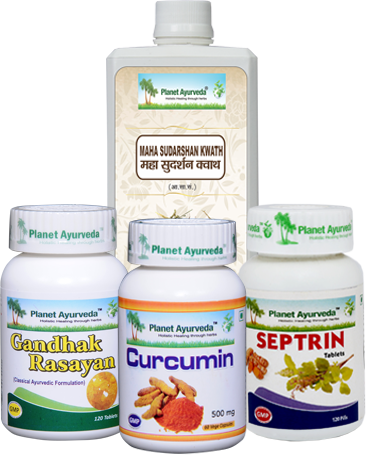
Planet Ayurveda is an ISO certified company which is also having certification of HALAL, KOSHER, FDA and others. The herbal preparations manufactured by Planet Ayurveda are in the form of tablets (vati), capsules, syrups, decoctions (kwath), jams (avaleha) and others. The products prepared by Planet Ayurveda are totally herbal and do  not contain any type of adulterants, fillers, dyes, flavour enhancing agents, binders etc. The herbal preparations manufactured or prepared by Planet Ayurveda are potent and are used in various types of conditions. The formulations offered by Planet Ayurveda for Monkeypox includes the following:

PRODUCTS LIST

  1. Curcumin Capsules
  2. Septrin Tablets
  3. Maha Sudarshan Kwath
  4. Gandhak Rasayan

Herbal Remedies for Monkeypox

PRODUCT DESCRIPTION

1. Curcumin Capsules

Curcumin Capsules are manufactured by Planet ayurveda with the potent and effective chemical constituent of Haridra (Curcuma longa). This chemical constituent is popularly known by the name curcumin. The capsules play a very great role in subsiding any type of inflammation ongoing in the body and also helps in healing after formation of crust. They also help in clearing out the toxins from the system and pacify pitta dosha as well. Haridra or haldi is quite famous in the Ayurvedic text for its immune strengthening specification as well.

Dosage - One capsule twice a day after meals with lukewarm water.

2. Septrin Tablets

Septrin Tablets are one of the most effective formulations of Planet ayurveda. The tablets are prepared with herbs such as Guggul (Commiphora mukul), Haldi (Curcuma longa), Tulsi (Ocimum sanctum), Sonth (Zingiber officinale), Marich (Piper nigrum) and Pippali (Piper longum). The ingredients make a perfect combination and help in the strengthening of the entire immune system and thus makes the body capable enough of fighting the virus on its own. In addition septrin tablets remove the deposited endotoxins accumulated in the microchannels and thus help in proper flow of bodily fluids and doshas.

Dosage - Two tablets twice a day after meals with lukewarm water.

3. Maha Sudarshan Kwath

Maha Sudarshan Kwath is a classical formulation which is prepared using potent herbs. The kwath is prepared using ancient methods of kwath preparation. The formulation is prepared with herbs like Badi Harad (Terminalia chebula), Bahera (Terminalia belerica), Amla (Emblica officinalis), Haldi (Curcuma longa), Daruhaldi (Berberis aristata) and many others. Maha sudarshan kwath is a very effective formulation which helps in combating fever and protects against harmful microorganisms as well. The formulation aids in management of fever in this case and also eliminates endotoxins accumulated in the body. In addition the kwath has great results in debility, cough and breathing difficulties as well.

Dosage - Two tsp twice a day after meals with lukewarm water.

4. Gandhak Rasayan

Gandhak Rasayan is also a classic mentioned formulation which is known to give best results in skin disorders. But apart from that the formulation has many other great effects as well. Gandhak rasayan is prepared using shuddha gandhak that is purified form of Sulphur alone. It is also very well known to boost immunity and enhances the body’s power to fight against diseases. In addition, gandhak is known to give deeper effects and hence has its effect on dhatu as well. Gandhak rasayan is a very great formulation and helps in body detoxification also.

Dosage - Two tablets twice a day after meals with lukewarm water.

CONCLUSION

The diseases like monkeypox can outbreak any time and you can only be able to protect yourself from such infections by just one way: By keeping your defence system strong. This is only possible if you start living a life of discipline and do look after what you eat and how you live. Observing things going on with your body can bring a lot of positive changes. As mentioned before monkeypox can spread from one person to another and even from your pet to you. So such infections can be prevented best by keeping your immunity strong so that you can’t be the culprit of these infections and neither be the supplier of such infections. The herbal formulations mentioned above are totally natural and are free from any type of additives or adulterants. They give the best rest in enhancing your immunity and even make your condition better if you are suffering from monkeypox.